
Password Strength Checker
Purpose
For my project, I created a password strength checker designed for educational and cybersecurity research purposes. The main goal was to understand what makes a password secure, how attackers crack weak credentials, and most importantly how to help users build stronger and safer passwords. Developing the tool gave me hands-on experience with concepts like entropy calculation, pattern detection, and identifying common vulnerabilities such as short length, lack of character diversity, or predictable sequences. I also implemented checks against lists of commonly used or leaked passwords to simulate real‑world attack scenarios. To ensure privacy and security, the tester never stores or transmits any password data; everything is evaluated in memory during the session. Overall, the project helped me better understand modern authentication security and the techniques used both to strengthen and to compromise passwords.
How it was built
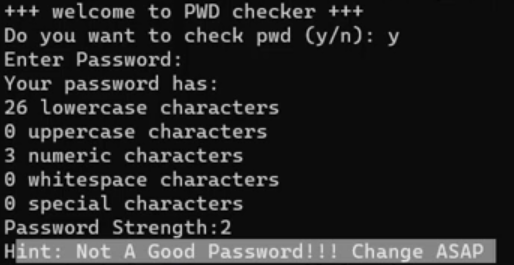
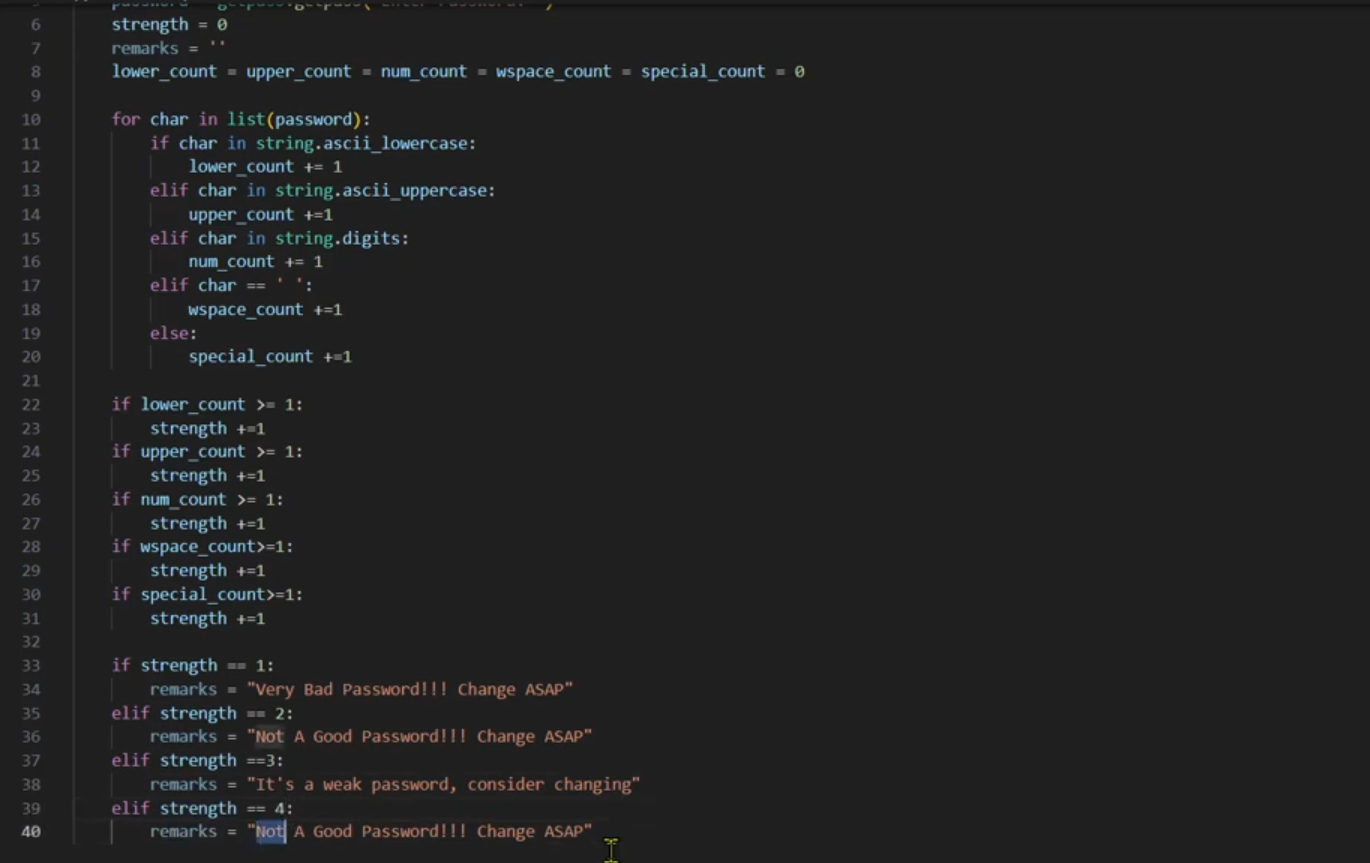
To build the password strength tester, I developed it in Python and designed it to analyze passwords based on several security criteria. The program runs locally and evaluates things like length, character variety, common patterns, and whether the password appears in known weak password lists. It then outputs a score along with suggestions to improve the password’s security.
Importance
Another important aspect was recognizing the security implications of handling sensitive data like passwords. Even though this was a controlled project, it taught me how important it is to avoid storing passwords, logging them, or transmitting them insecurely. Building the tool reinforced the idea that cybersecurity isn’t just about writing code that works — it’s also about writing code that respects user safety and privacy. Understanding how weak passwords are detected helps cybersecurity professionals defend against credential-stuffing attacks, brute-force attempts, and other authentication-related threats.
Summary
Overall, the project wasn’t just about checking if a password was strong—it was about understanding the entire lifecycle of how secure authentication is built. Creating the password strength tester helped me see how user input can be evaluated, scored, and validated based on real security standards. I learned how different factors like length, complexity, and character variety impact security, and how weak passwords can be identified before they ever put a system at risk. If I continue improving it, I’d probably add features like real-time feedback while typing, suggestions for making the password stronger, or even integrations that compare passwords against known breach databases. That way, the project becomes not only a useful tool for users, but also a practical demonstration of how to help prevent common security vulnerabilities.